
AFCN 2023
Between July and November 2023, the REVIVART Association, in partnership with the National University of Music in Bucharest, the Center for Studies on 19th Century Music (CNCMS), the National and Kapodistrian University of Athens, the Faculty of Theology of the University of Eastern Finland, and several other public and private institutions, carried out the project “Hermetic Musical Systems and Hermeneutic Needs (SEMNE),” which aimed to disambiguate and reintroduce into the interpretative circuit repertoires captive in three musical notation systems used between the end of the 17th century and the middle of the 19th century: Kiev notation, Petru Efesiul’s alphabetic notation, and Gheorghios Lesvios’ neumatic notation.
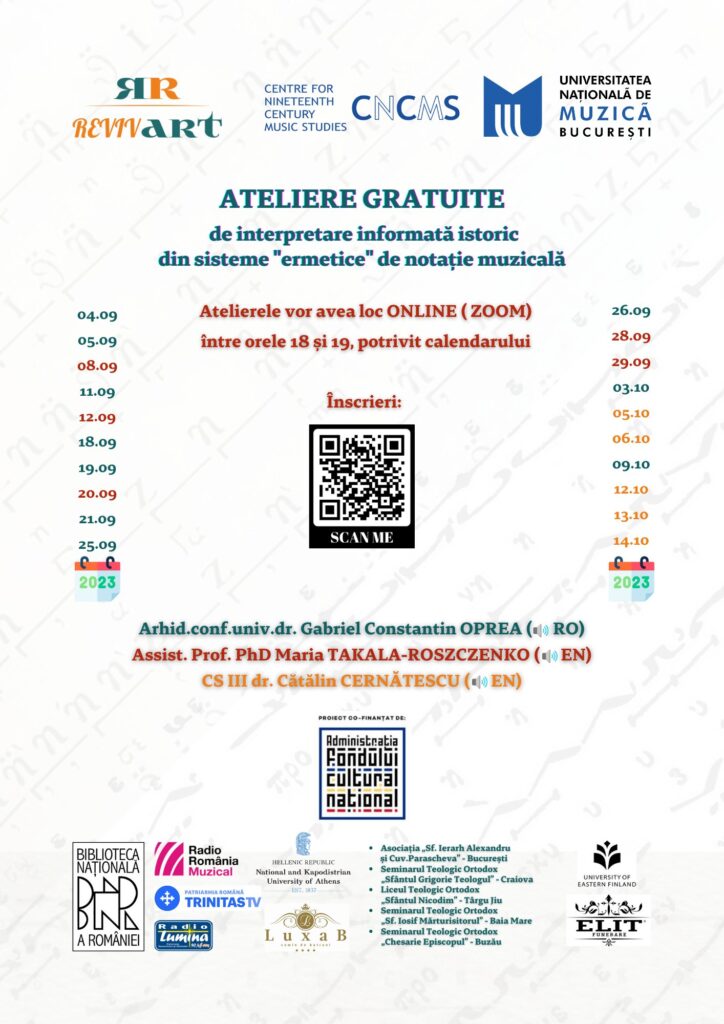
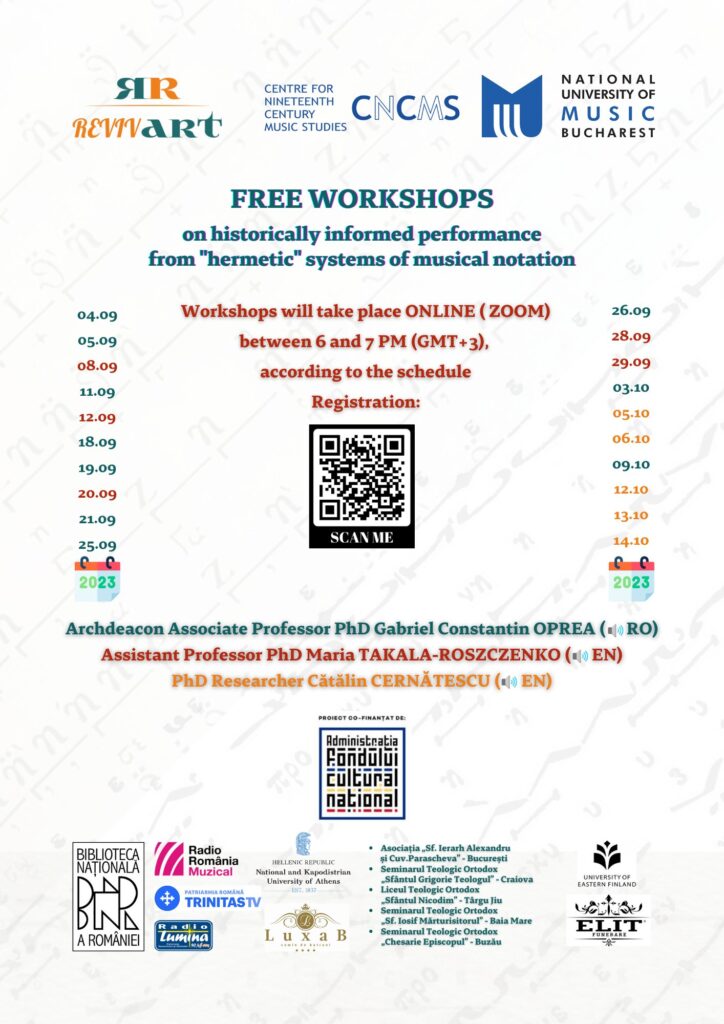
The beneficiaries of the project activities had access to no less than 40 hours of interactive online activities: twenty “second chance” workshops led by Dr. Ștefan Aurel Ștefan, designed to introduce beginners to Western and Byzantine music, ten workshops on historically informed music performance, held by Archdeacon Gabriel Constantin Oprea from UNMB, and ten other workshops on familiarizing participants with obsolete musical systems, coordinated by Maria Takala-Roszczenko from the Faculty of Theology at the University of Eastern Finland and Dr. Cătălin Cernătescu from UNMB. All workshops were published as open educational resources on the YouTube channel of the REVIVART Association, constituting a substantial archive of information in the field of Byzantine music theory and an auxiliary tool for music education for those who wish to familiarize themselves with the notation systems in which Orthodox chant has circulated over time.
Between July 1 and November 19, 2023, no fewer than 7,576 beneficiaries from 10 countries (Romania, Greece, Germany, Austria, Italy, Spain, the United Kingdom, the Republic of Moldova, the United States, and Luxembourg) watched approximately 401.4 hours of video content produced as part of the AFCN project, which had 149,679 views on YouTube. Similarly, on Facebook, approximately 30,000 people interacted with the pieces reconstructed as part of the AFCN project.
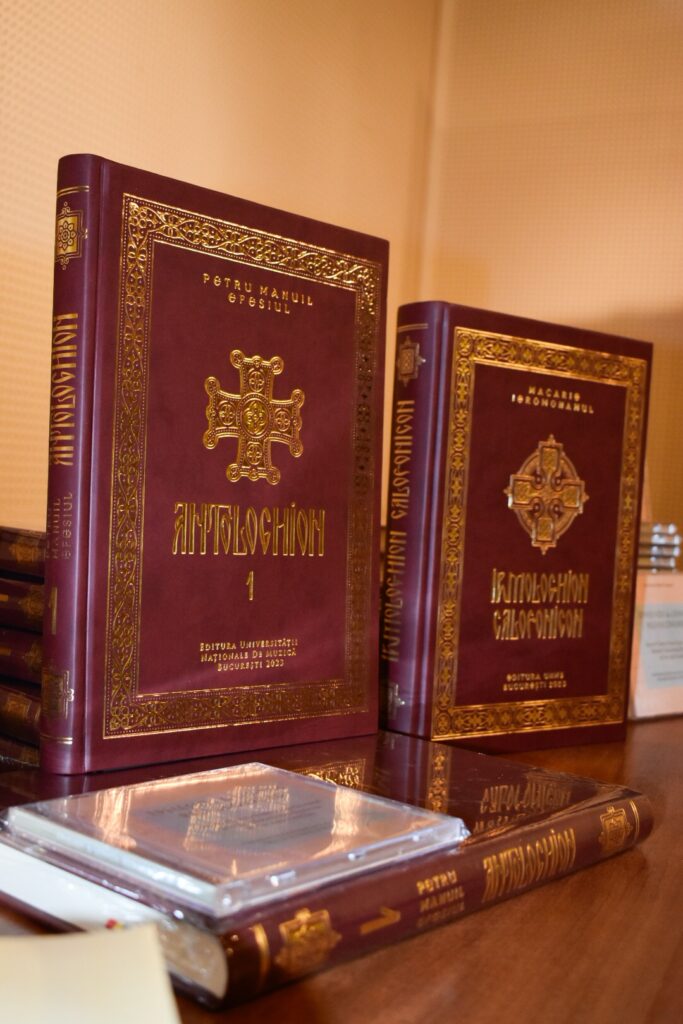
In order to carry out the research activities outlined in the implementation plan, the team coordinated by musicologist Nicolae Gheorghiță investigated musical documents from several dozen libraries in Romania and abroad, comparing various versions of the pieces that were the subject of the sound reconstruction. The main objective of the research was to select and popularize songs from Petru Efesiul’s alphabetical Anthology, printed in 1832 in Bucharest.
As part of the SEMNE project, the songs between pages 4 and 140 of the print were deciphered, representing approximately 274 pages of exquisite music, spelled and transcribed from the alphabetical system into the chrysanthic system.